2027 Autonomous Pool Care Trend: Why AI Water Quality Management Is the Next Growth Engine for Pool Cleaning Robot Manufacturers
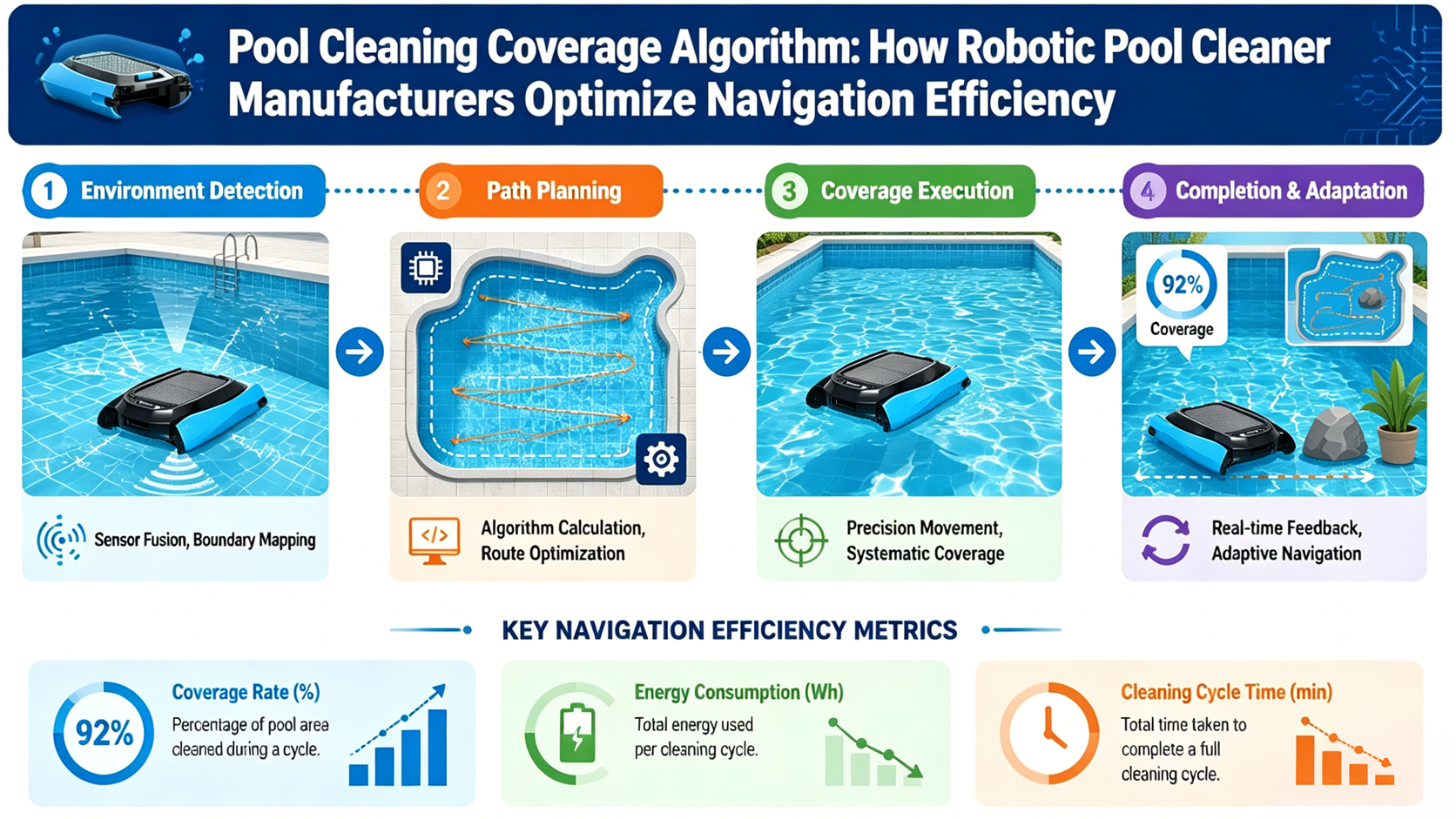
What happens when a pool cleaning robot no longer focuses solely on debris removal but becomes an autonomous water management system? That question is rapidly moving from concept to commercial reality. As the global pool industry continues its transition from manual maintenance to intelligent automation, AI-powered water quality management is emerging as the next major value driver for every pool cleaning robot manufacturer.
By 2027, the competitive landscape is expected to shift beyond navigation accuracy, suction performance, and wall-climbing capabilities. Instead, manufacturers that integrate water quality monitoring, predictive maintenance, automated chemical balancing, and AI decision-making into their robotic platforms will be positioned to capture higher-margin opportunities and create recurring service ecosystems.
For pool equipment brands, distributors, facility operators, and OEM/ODM partners, understanding this transition is critical. This article explores why AI water quality management is becoming the next growth engine for the industry, how the technology is evolving, and what strategic actions stakeholders should take in 2027 and beyond.
The Evolution of Pool Cleaning: From Labor Reduction to Autonomous Pool Intelligence
The pool cleaning industry has experienced four major stages of development:
| Development Stage | Primary Function | Key Limitation |
|---|---|---|
| Manual Cleaning | Human-operated maintenance | Labor-intensive and inconsistent |
| Pressure & Suction Robots | Basic automated cleaning | Dependent on pool systems and random navigation |
| Smart Navigation Robots | Autonomous route planning and coverage | Limited awareness of water chemistry |
| AI Water Quality Management | Integrated cleaning, monitoring, prediction, and treatment | Emerging technology ecosystem |
According to industry observations and technology roadmaps from leading robotic solution providers, including Shenzhen Haixin Robot Technology's Hysheen brand, the next stage of innovation centers on transforming pool robots into intelligent pool management platforms capable of understanding both physical contaminants and water conditions.
In practical terms, the robot evolves from being a "cleaning tool" into a "digital pool caretaker."
Why AI Water Quality Management Is Becoming the Industry's Defining Trend
AI-Powered Water Monitoring Moves Beyond Cleaning
Traditional robots focus primarily on collecting leaves, debris, hair, fibers, and other contaminants. However, pool health depends equally on invisible variables such as pH levels, chlorine concentration, alkalinity, and dissolved solids.
According to the U.S. Centers for Disease Control and Prevention (CDC), maintaining proper disinfectant and pH levels is essential for swimmer safety and water quality management.
The next generation of AI-enabled systems is expected to continuously monitor water conditions through onboard sensors, enabling real-time analysis rather than periodic manual testing.
Key Drivers:
- Growing consumer demand for convenience
- Increased adoption of smart home ecosystems
- Advances in IoT sensor technology
- Lower costs of embedded AI computing
Industry Impact:
- Equipment suppliers gain new sensor opportunities
- Manufacturers increase product differentiation
- Service providers reduce maintenance visits
- Pool owners receive healthier water conditions
Predictive Water Chemistry Becomes a New Revenue Layer
One of the most promising applications of AI is predictive analytics. Instead of simply reporting current water conditions, future systems will forecast chemical imbalances before they occur.
Research from McKinsey's AI studies highlights how predictive AI increasingly drives operational efficiency across industries by anticipating events and optimizing responses.
Applied to pools, AI algorithms can analyze:
- Weather conditions
- Pool usage patterns
- Historical chemical trends
- Seasonal environmental changes
- Contamination risk factors
This capability creates opportunities for subscription-based monitoring services, recurring software revenue, and enhanced customer retention.
Industry Impact:
- Higher lifetime customer value
- Expansion into service-based business models
- Reduced chemical waste
- Improved maintenance efficiency
Autonomous Chemical Dosing Completes the Automation Loop
Cleaning is only one component of pool maintenance. Chemical treatment remains labor-intensive and prone to human error.
Future AI pool care systems are expected to integrate:
- Water quality sensing
- Automated chemical dispensing
- Machine learning optimization
- Remote management platforms
The result is a closed-loop system capable of detecting, deciding, and acting without requiring constant human intervention.
Industry Impact:
- Enhanced user experience
- Reduced operating costs
- Increased premium product demand
- Expansion of smart pool ecosystems
Data-Driven Outlook for 2027
The broader smart home and IoT industries provide a useful benchmark for understanding the trajectory of autonomous pool care.
According to Statista, global IoT adoption continues to expand across residential and commercial applications, while AI-enabled automation is becoming a standard expectation rather than a premium feature.
Although exact adoption rates for AI water quality management remain uncertain, several industry indicators point toward accelerated commercialization through 2027.
2024 2025 2026 2027 Baseline Connected AI Monitoring Autonomous Industry Technology Maturity Progression
Illustrative technology maturity progression based on industry development trends, smart automation adoption patterns, and IoT integration trajectories reported by Statista, McKinsey, and leading robotics manufacturers.
Expected Market Characteristics by 2027
| Area | Expected Direction |
|---|---|
| Sensor Integration | Standard feature in premium robots |
| AI Analytics | Increasingly cloud-connected |
| Chemical Automation | Growing commercial deployment |
| Subscription Services | New revenue stream for manufacturers |
| Multi-Robot Coordination | Emerging in large facilities |
While adoption speed will vary by region, the overall direction is clear: autonomous pool care is becoming a platform opportunity rather than a standalone hardware category.
Opportunities and Challenges for Pool Cleaning Robot Manufacturers
Growth Opportunities
- Premium AI-enabled product categories
- Recurring software and monitoring subscriptions
- Water quality management ecosystems
- Smart home integration partnerships
- Commercial pool automation expansion
- Data-driven maintenance services
Key Challenges
- Sensor accuracy and reliability requirements
- Regulatory compliance across markets
- Higher R&D investment costs
- Cybersecurity and data privacy concerns
- User education and adoption barriers
- Complex integration with treatment systems
The winners of 2027 may not necessarily be the companies with the strongest suction power. Instead, they are likely to be the manufacturers capable of creating integrated intelligence platforms that combine robotics, AI, cloud services, and water management expertise.
Practical Action Guide for Industry Stakeholders
For Strategic Decision Makers
- Prioritize investment in sensor-enabled AI platforms rather than standalone cleaning functions.
- Explore recurring revenue opportunities through monitoring and analytics services.
- Develop strategic partnerships with water treatment technology providers.
- Build long-term software capabilities alongside hardware innovation.
For Product and Engineering Managers
- Integrate water quality sensing into future product roadmaps.
- Expand AI model development for predictive maintenance and chemistry analysis.
- Enhance cloud connectivity and remote management features.
- Establish data collection frameworks to improve machine learning performance.
For Industry Buyers and Brand Owners
- Evaluate suppliers based on AI capabilities, not only cleaning performance.
- Assess software scalability and ecosystem compatibility.
- Prioritize platforms that support future upgrades and autonomous features.
- Partner with manufacturers capable of rapid customization and ODM development.
How Shenzhen Haixin Robot Technology Supports the Transition
As the industry moves toward AI-driven autonomous pool care, Shenzhen Haixin Robot Technology's Hysheen brand is strategically aligned with this direction.
Hysheen focuses on intelligent outdoor service robots, with particular emphasis on AI-powered pool cleaning and garden robotics. The company's technology roadmap already identifies AI water quality management as the next evolution beyond smart navigation robots.
Its OEM/ODM capabilities, annual production capacity, global export experience across more than 100 countries, and flexible customization services position the company to support brands seeking to accelerate innovation in autonomous pool care solutions.
For organizations exploring next-generation pool robotics, integrating AI, water quality monitoring, and intelligent automation into product roadmaps today can create a significant competitive advantage by 2027.
To discuss customized AI pool robot development, OEM/ODM manufacturing, or autonomous water quality management solutions, schedule a consultation with our experts and explore how intelligent pool care can become your next growth opportunity.
Conclusion
The pool cleaning robot industry is entering a transformative period. Navigation and cleaning performance will remain important, but they are increasingly becoming baseline expectations.
The next frontier lies in AI water quality management—systems capable of monitoring, predicting, and autonomously optimizing pool health. For every forward-looking pool cleaning robot manufacturer, this shift represents more than a technology upgrade; it represents an entirely new business model built around intelligence, automation, and recurring customer value.
By 2027, the companies that successfully combine robotics, AI, sensing technologies, and water chemistry management will be best positioned to lead the future of autonomous pool care.
References
- CDC Healthy Swimming Program — Water chemistry and swimmer safety guidance.
- McKinsey State of AI Research — Enterprise AI adoption and predictive analytics trends.
- Statista IoT Industry Overview — Global IoT adoption and connected device trends.
- International Organization for Standardization (ISO) — Standards relevant to connected devices and quality systems.
- Hysheen Official Website — Company information, product vision, and manufacturing capabilities.